They are choosing a hand, not a studio.
The work is the navigation, booking is deposit-locked, and consent and aftercare sit on the client record instead of in a folder behind the counter.
Both voices are synthesized and the business is one of our own examples. This is what the agent does, not a customer’s call.
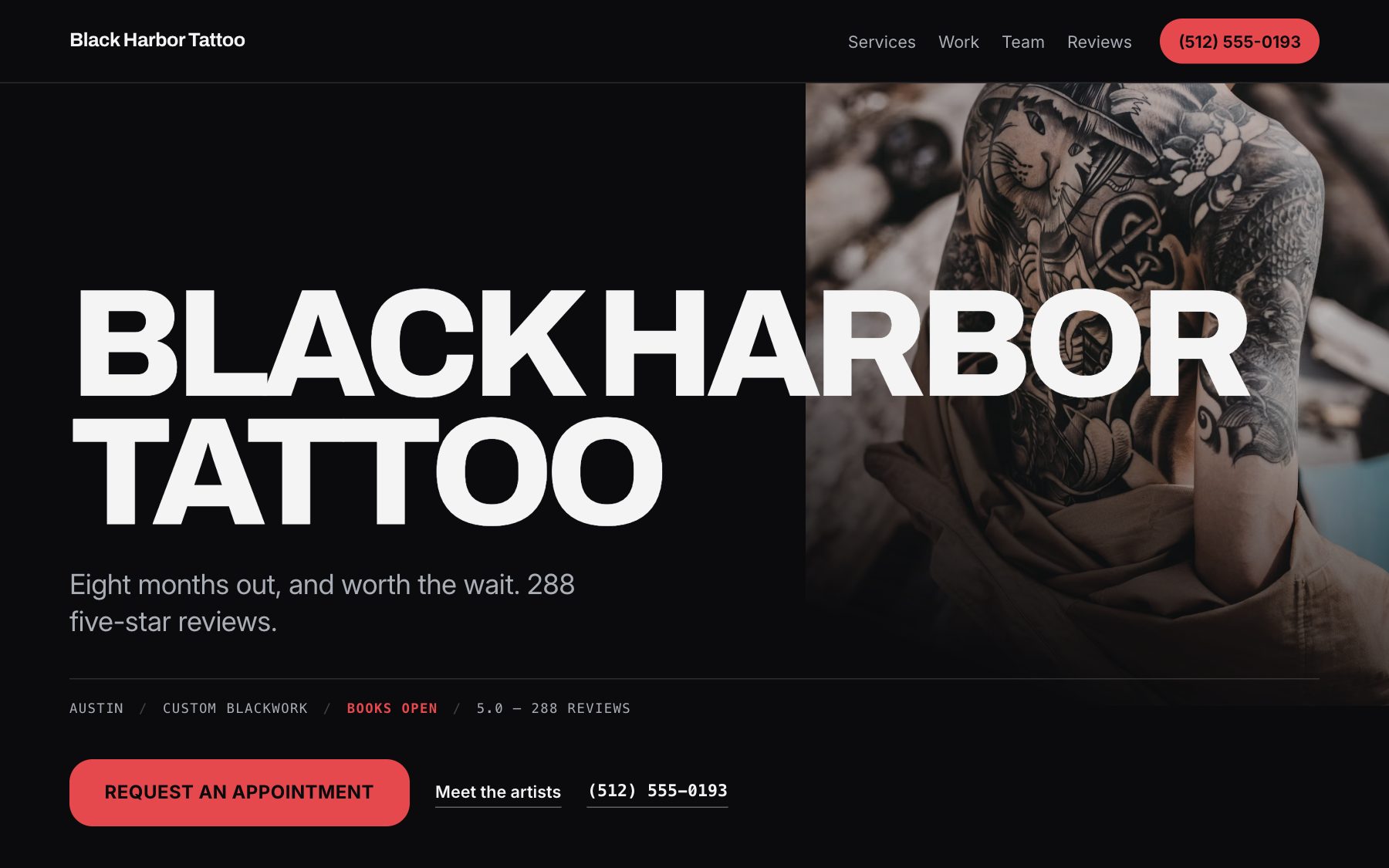
Open the live site → The work walked past, not scrolled down
A demonstration site for a business we invented. The rating and the review count on it are not real.
Talk to the front desk of a tattoo studio.
A live agent answering as Black Harbor Tattoo, quoting only from that shop’s price book. Ask it for a price the book does not hold and watch it refuse rather than guess.
Call the Black Harbor Tattoo front desk.
It answers with the recording notice, quotes only from that shop’s price book, and books against real slots — and it refuses to guess at anything the book does not contain. Ask it for a price it does not have and watch what it does.
Nothing is recorded and nothing is stored. You can type instead of talking. Both voices in the recording below are synthesized; this one is a live model answering you.
Why do tattoo studios lose bookings they never see?
A tattoo studio's inquiries arrive as messages about work the artist has not agreed to do yet, and the booking is lost in the gap between that first message and a deposit. The portfolio does the selling, because an inquirer is choosing an artist's hand rather than a studio, and the deposit does the qualifying, because an appointment without one is a chair that may sit empty for four hours. Orabeam builds tattoo sites where the work is the navigation: artists have their own pages, healed photographs sit beside fresh ones, and the flash wall is bookable directly. Booking is deposit-locked, so a slot is only held once money has moved. The module keeps consent and aftercare records against the client, the deposit ledger with its forfeiture rules, and per-artist commission. The AI front desk answers overnight, screens by placement and size, and never quotes a price the artist has not set.
The inquiry is a conversation about work that does not exist yet. Everything between the first message and a deposit is where studios lose the chair. First-party: how the trade works. No published split we can stand behind.
Three things we build in for tattoo studios.
The work is the navigation
Artists have pages, not a shared gallery. An inquirer is picking a hand, and a mixed grid hides whose hand it was.
Healed beside fresh
Anyone can photograph a fresh piece. Showing it healed at six months is the proof other studios do not publish.
Deposit-locked booking
A held chair with no deposit is four hours you cannot sell. Money moving is the qualification.
What a generic CRM cannot hold for a tattoo studio.
This is the Command tier, and it is the reason it exists. These are not custom fields.
- Per-artist pages, portfolios and commission splits
- Flash wall with directly bookable pieces
- Deposit ledger with forfeiture and transfer rules
- Consent, age verification and aftercare records on the client
- Touch-up windows tracked against the original session
Running software. No sign-up.
Buy the software once. Pay monthly only for the AI.
Running & Care is $79 a month. One booked hour in the chair at $180 covers 2 months of it. The AI front desk plans start at $297 and include it.
Launch
$1,000 one-time, and yours
Look credible, stop losing web leads. One location.
Thirty days, three numbers, or your money back.
Growth
$1,500 one-time, and yours
The phone answered. The quote followed through.
Thirty days, three numbers, or your money back.
Command
$2,500 one-time, and yours
Multi-location, or compliance a generic CRM cannot hold.
Thirty days, three numbers, or your money back.